
On this page
Where Redmond's steep slopes are
Redmond's hazard plan defines landslide hazard areas as slopes steeper than thirty degrees, plus a fifty-foot buffer above and below them. It places the city's steep slopes primarily on the western and southeastern portions of Education Hill and along Redmond's northwestern border in Willows/Rose Hill. Outside the city, sloping ground runs down from the plateaus around Union Hill-Novelty Hill and Sammamish, and Idylwood sits on sloped terrain above Lake Sammamish.
Why water is the trigger
The hazard plan notes that landslides occur during unusual heavy seasonal rains or during an earthquake. It also records a telling local example: in January 1997, a substantial landslide occurred on the southwest side of town when a hillside gave way because of excessive water overflowing storm drains and culverts at the top of the hill.
A roof collects rain from a large area and concentrates it at a few downspouts. If one of those downspouts discharges at the top of a slope, it adds a steady stream of water to exactly the soil that needs to stay dry, and does it through the wettest months, when Redmond averages close to 5 inches in November and 5.5 in December.
Safe and unsafe discharge
| Discharge | On a slope |
|---|---|
| Onto the slope face | Unsafe |
| At the top of a slope | Unsafe |
| Into a dry well or rain garden near the slope | Usually unsafe; can saturate soil |
| Tightline to the street drainage system | Usually the right answer; may need review |
| Tightline down the slope to an approved outlet | Possible with engineering and approval |
| Dispersion onto flat, vegetated ground well away from the slope | Sometimes acceptable |
Warning signs
- New cracks in the ground, driveway or foundation.
- Doors or windows that start to stick.
- Leaning fences, retaining walls or trees.
- Water seeping from the slope.
- Soil washing out below downspouts or drain outlets.
- Bulging ground at the foot of a slope.
If you see signs of movement, contact the City of Redmond, or King County if you are outside the city, and call 911 if anyone is in danger.
Gutter work on a sloped lot
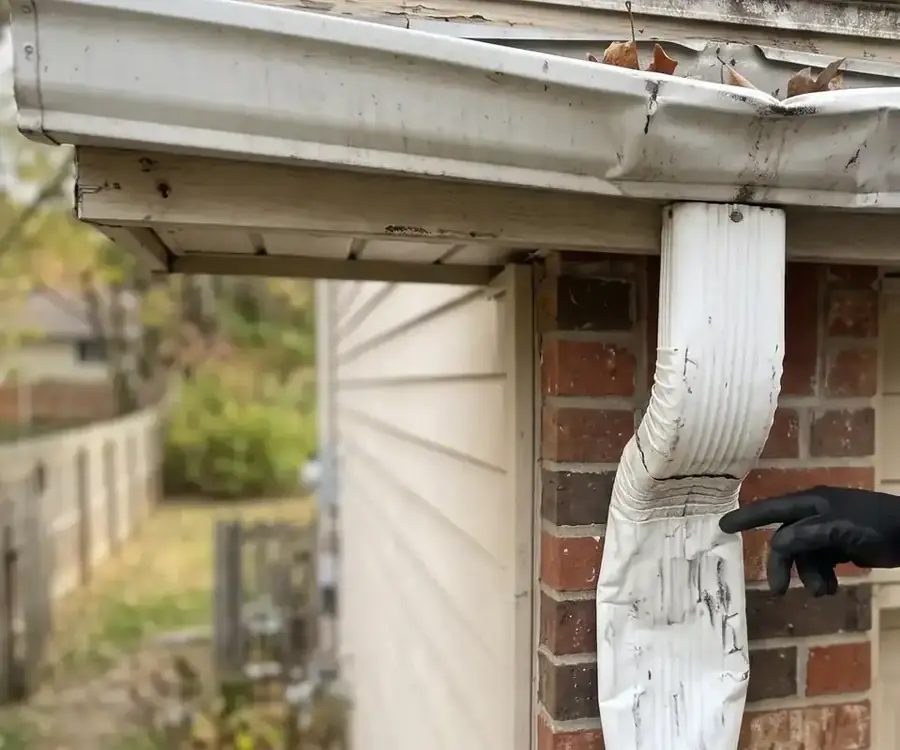
Keep the gutters flowing. Overflow on the uphill side drops water at the top of the slope. Cleaning and micro-mesh guards help.
Check every downspout. Know where each one goes. Old buried lines can be broken or disconnected underground.
Tightline where needed. Solid pipe carries water past the slope to an approved discharge point.
Do not add infiltration near slopes. Dry wells and rain gardens put water into the ground, which is the opposite of what a slope needs.
Involve the right people. For steep or unstable slopes, a geotechnical engineer and city or county review may be needed. A gutter contractor can do the gutter and downspout side.
Before the wet season
Because slides follow heavy seasonal rain, early fall is the time to check drainage on a sloped lot:
- Clean the gutters so they do not overflow at the top of the slope.
- Walk each downspout to its discharge point.
- Flush underground lines and make sure they come out where expected.
- Look for new cracks, soft ground or seepage on the slope.
- Fix or reroute anything that sends water onto the slope.
A worked example
Here is an illustration. A house on the west side of Education Hill has a rear downspout that discharges onto the lawn at the top of a steep bank. After a wet winter, soil below it starts to wash out. The fix is to tightline that downspout around the house to the street drainage, with any approvals needed, and to check the other downspouts and old drain lines.
Before the wet season
Because slides follow unusual heavy seasonal rains, early fall is the time to check drainage on a sloped lot:
- Clean the gutters so they do not overflow at the top of the slope.
- Walk each downspout to its discharge point.
- Flush underground lines and make sure they come out where expected.
- Look for new cracks, soft ground or seepage on the slope.
- Fix or reroute anything that sends water onto the slope.