
On this page
Why drainage matters
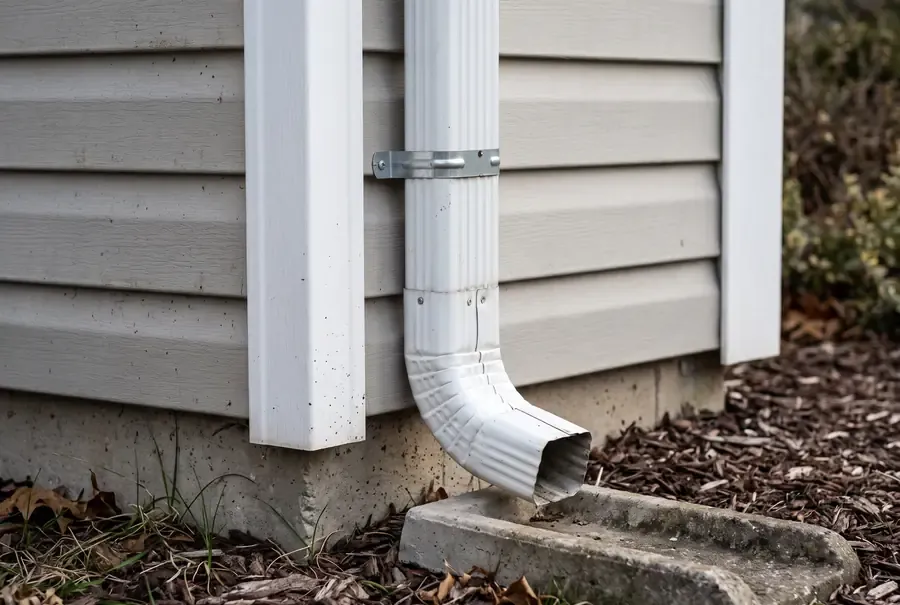
A roof sheds a lot of water. Redmond averages about 36 inches of precipitation a year, so even a modest roof collects many thousands of gallons over a wet season. If the downspouts dump it at the foundation, it soaks the soil against the walls, wets crawlspaces and basements, and can undermine footings, steps and walkways.
Where downspouts can go
| Option | How it works | Good for | Watch for |
|---|---|---|---|
| Extension or splash block | Carries water a few feet from the wall | Yards that slope away | Gets moved by mowers; must slope away |
| Buried drain line | Pipe carries water further | Yards where surface extensions are in the way | Needs cleanouts; can clog with needles |
| Tightline to storm drainage | Solid pipe to an approved point | Sloped and tight lots | May need review for new connections |
| Dispersion trench | Spreads water across a vegetated area | Larger lots with room | Not near slopes or foundations |
| Dry well or infiltration | Lets water soak into the ground | Suitable soils away from buildings | Check aquifer rules in Redmond first |
| Cistern or rain barrel | Stores roof water | Garden use | Overflow must go somewhere safe |
Redmond's aquifer
Redmond is unusual among Eastside cities: it draws part of its drinking water from wells in a shallow aquifer, and it classifies the land above it as critical aquifer recharge areas according to how quickly groundwater reaches a city well. King County notes that across the Redmond-Bear Creek Valley groundwater area, 44 square miles north of Lake Sammamish, most of the water used comes from groundwater.
Clean roof water soaking into a lawn is not the issue. What the rules care about is what water picks up on the way down and how new infiltration is built. Keep downspouts away from driveways, oil and garden chemicals, and check with the city before adding a new dry well or infiltration system.
Streams and wet areas
On Redmond's east side, Bear Creek and its tributaries Cottage Lake Creek and Evans Creek drain a 32,100-acre watershed, and King County notes that Evans Creek carries chinook, coho and sockeye salmon. Downspouts on lots near these streams should discharge gently onto vegetated ground or into the storm system, not onto bare soil that washes toward the bank.
Slopes are different
Redmond's hazard plan places the city's steep slopes mainly on the west and southeast sides of Education Hill and along the Willows/Rose Hill border. On those lots, downspouts should never empty onto the slope. See downspouts on steep slopes.
Signs of drainage trouble
- Damp or musty crawlspace or basement after rain.
- Water stains or white mineral deposits on foundation walls.
- Soil washed away at downspout outlets.
- Puddles against the foundation.
- Cracks in steps, patios or walkways near downspouts.
- Water flowing toward a neighbor's property.
- New cracks or soft ground on a slope.
Simple fixes
- Add extensions so water discharges well away from the wall.
- Regrade the soil so it slopes away from the house.
- Clear buried lines that have clogged with needles and moss.
- Reroute downspouts off slopes and away from neighbors.
- Check before you infiltrate. In Redmond's aquifer areas, confirm the rules before adding a dry well.
A worked example
Here is an illustration. A 1970s house in Grass Lawn has four downspouts: two run into old buried pipe and two discharge onto splash blocks beside the foundation. The crawlspace is damp under one of the splash blocks. Adding extensions to carry water across the lawn fixes the damp, and flushing the buried pipes shows one is packed with needles. Clearing it and adding a cleanout restores flow.
Checking your downspouts in the rain
The best time to check drainage is during a steady rain. Walk around the house and note at each downspout: does water flow out freely, where does it go, does it pool, and does it run back toward the house? Water bubbling up from the ground near an underground line, or a downspout that backs up and overflows at the top, means the line below is blocked or broken.